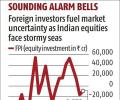
Foreign portfolio investors (FPIs) have withdrawn Rs 25,305 crore from domestic markets since September. FPIs were net sellers in the first two months of 2023, but from March to August, they purchased equities worth Rs 1.7 trillion. This selling trend has caused the National Stock Exchange Nifty Index to decline by 3.2 per cent from its September highs. FPI selling initially began in September as profit-taking but intensified due to rising US bond yields and uncertainty regarding the rate hike trajectory.

Draft Red Herring Prospectus (DRHP) filing continued to be robust in October, signifying the optimism in the initial public offer (IPO) market despite the recent turbulence in equities. In October, 17 companies filed their offer documents for IPOs. The rush in filings has made August-October 2023 the best three-month period for DRHP filings since July-September 2021.

The fees charged by investment banks to manage initial public offerings (IPOs) have increased to an average 3.23 per cent of the issue size this calendar year, the highest since 2020. The average fee is up 8 per cent compared to last year, when it stood at 2.99 per cent. The investment banking fees have increased as the average IPO size has shrunk this year.

As many as 267 of 453 companies from the BSE500 index are trading above their consensus price targets, according to the data compiled by Bloomberg. Not all companies in the BSE500 index are tracked by analysts.
As many as 31 mainboard IPOs raised a cumulative Rs 26,272 crore in this period, according to Prime Database. During the April-September 2007 bull run, 48 IPOs totalling Rs 21,243 crore were launched. The number of deals in H1FY24 was 2.2 times that of the same period of the last fiscal year, but the amount raised was 26 per cent lower.
With the Nifty50 surging past the 20,000 mark, the markets are experiencing a spate of initial public offerings (IPOs) with four issues set to raise over Rs 4,673 crore this week. Another quartet, cumulatively worth Rs 3,000 crore, is expected to launch next week. Companies like RR Kabel, SAMHI Hotels, Zaggle Prepaid Ocean Services, and Yatra Online are set to hit the primary market this week, while Signature Global, Updater Services, Sai Silks (Kalamandir), and Vaibhav Jewellers are slated for next week. This flurry of activity is driven by multiple factors including buoyant market conditions, increased demand for IPOs, and specific rule on the disclosure of quarterly financials.
Water projects firm Vishnu Prakash R Punglia, the 20th company to launch its IPO in the current year, saw its shares closing at a 47 per cent gain over its issue price on Tuesday. Such a huge one-day pop is considered rare; however, it has become the norm this year. The average listing-day gain for these 20 IPOs in 2023 is 34 per cent, and their average gain to date stands at 46 per cent.

Notwithstanding the ongoing decline in equity markets week after week, August has proven to be the most successful since December for initial public offerings (IPOs). In August of this year, six companies have collectively raised approximately Rs 4,269 crore through IPOs.

The benchmark indices are set to end their five-month gaining streak, but the market breadth continues to hold strong So far this month, stocks gaining have outnumbered those declining, a sign that the bulls still have the upper hand, even as the pullback in the S&P BSE Sensex and the National Stock Exchange Nifty indicates otherwise. On the BSE, 2,126 stocks have advanced and 1,955 have declined in August, translating into an advance/decline ratio (ADR) of 1.1.

French banking major BNP Paribas is planning to sell its domestic retail broking unit, Sharekhan, according to news reports on Tuesday. The reports even named leading financial institutions as possible suitors. "We would not be able to comment on the mentioned queries at this time," said a company spokesperson in response to a query from Business Standard seeking clarification on the news item.

After pumping in close to $20 billion in the preceding five months, foreign portfolio investors (FPIs) have yanked out $220 million from domestic stocks this month. The selling by overseas funds has led to turbulence in the domestic markets, with benchmark indices swinging wildly recently.

Companies, which missed out on listing earlier, are giving it another shot but with significantly-reduced issue sizes. In the recent past, companies such as TVS Supply Chain Solutions, Suraj Estate Developers, and ESAF Small Finance Bank have re-filed their draft red herring prospectuses (DRHPs) with the Securities and Exchange Board of India (Sebi). This came after they slashed their issue sizes by 20-60 per cent.

'India has always been a bottom-up stock-picking market, and as growth recovers with higher liquidity, mid and small-caps always tend to outperform.'

The sharp jump in shares of Kalyan Jewellers (Kalyan) has surprised many on the Street; however, analysts believe more steam could be left in the stock as the Thrissur-based gold retailer pivots to a new asset-light network expansion model. Kalyan's stock has surged 62 per cent in the past month, even as the S&P BSE SmallCap Index has gained just 5 per cent. In its latest business update, the company said its consolidated sales grew more than consensus expectations at 31 per cent year-on-year, led by strong domestic sales regardless of the volatility in gold prices.

The gauge for the performance of informational technology (IT) stocks soared nearly 5 per cent-most in nearly three years-as growth worries eased following a robust order book posted by bellwether Tata Consultancy Services (TCS). The Nifty IT index rose 4.5 per cent to close at 30,945. This was the biggest single-day gain since September 14, 2020. Industry titan TCS' shares rose 5 per cent to Rs 3,509.

'As China's reopening euphoria fizzled out on the back of some disappointing economic data, we saw inflows coming back to India with full force in the past 3-4 months.'

The sharp rally in the broader markets has propelled India's market capitalisation (m-cap) to a new high. The combined m-cap of all BSE-listed firms rose to Rs 291.9 trillion in intraday trade on Thursday before settling lower at Rs 290.9 trillion. The previous record was on December 14, 2022, at Rs 291.3 trillion.

Corporate India's net profit as a percentage of gross domestic product (GDP) dipped in the 2022-23 financial year (FY23) -- after rebounding sharply in FY22 -- amid a decline in global commodity prices. Top 500 companies' combined net profit stood at 4.1 per cent of the GDP for FY23, down from 4.3 per cent in the previous financial year when it had gone up from just 3.5 per cent in FY21. "The year-on-year (YoY) decline was led by global commodities, which contributed adversely to the ratio, while the financial sector contributed positively.

Half of India's top-priced stocks have outperformed the benchmark indices this year. On a year-to-date basis (YTD), the Sensex has gained 3.8 per cent and the Nifty50 3.4 per cent. The stocks which have outperformed the indices include 3M India, Nestle India, MRF, Shree Cement and Bosch while those who have underperformed the benchmarks include Page Industries (-10.4 per cent), Procter & Gamble (-4 per cent), Honeywell Automation (-0.9) and Lakshmi Machine Works, which gained 1.3 per cent.

The initial public offering (IPO) market has seen some momentum of late with robust responses to recent issues. However, only some have been able to ride the wave. So far in 2023, 23 companies have let their approval granted by the markets regulator - the Securities and Exchange Board of India (Sebi) - lapse.
